Best Practices
How to remove coffee stains from office carpet
Coffee is the office carpet's natural predator. It travels from kitchen to desk several times a day per person, it is usually in motion when it spills, and it lands somewhere visible: the walkway, the meeting room, the patch in front of the lift.
A fresh coffee spill is one of the more forgiving stains, provided the first five minutes go well. The catch is that the instinctive responses (rubbing hard, reaching for hot water) are exactly what turns a removable spill into a permanent shadow.
What a coffee stain actually is
Coffee stains carpet with tannins, the same class of compounds that make tea and red wine so persistent. Tannins bond readily with carpet fibres, and heat accelerates the bond, which is why hot water, hairdryers and anything else warm are off the table until the stain is gone.
Office coffee adds two complications. Milk leaves a protein residue that can sour in the pile if it is not rinsed out properly, and sugar leaves a sticky trace that collects dirt, so a "removed" stain reappears as a grey patch weeks later. The method below deals with all three.
How to remove coffee stains from carpet
For a fresh spill, work through these steps in order. Stop as soon as the stain has gone. Every step you skip is wear you spare the carpet.
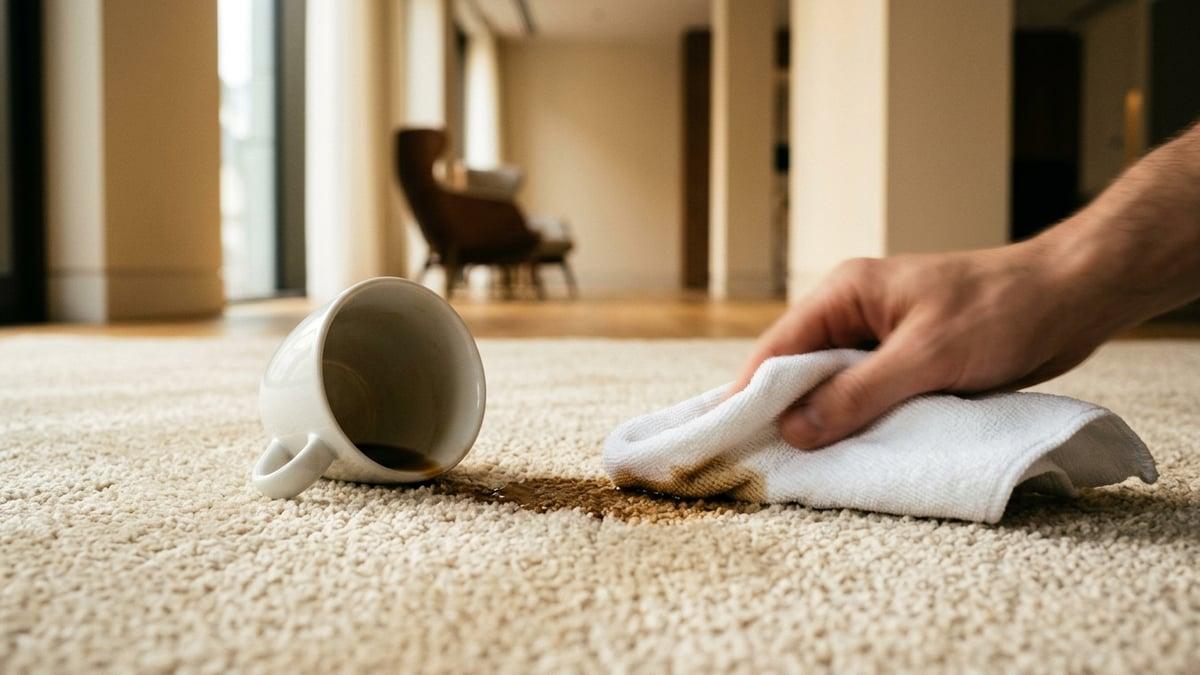
- Blot immediately with a dry white cloth or plain kitchen paper. Work from the outside of the stain towards the centre so you are not spreading it, and press rather than rub.
- Dampen a clean cloth with cool water, blot the area, and blot dry again with fresh paper. Repeat while colour keeps lifting onto the cloth; patience here does most of the work.
- If a mark remains, mix one tablespoon of washing-up liquid into half a litre of cool water. Apply a little with a cloth, leave it a few minutes, then blot it out. Do not pour solution onto the carpet.
- For a stubborn shadow, follow with a solution of equal parts white vinegar and cool water, applied and blotted the same way.
- Finish by blotting with plain cool water to rinse out any residue, then press dry towels onto the area (weight them down if you can) and let it dry fully before vacuuming the pile back up.
Worth knowing: a stain that reappears a day or two after cleaning has not survived the treatment. It has wicked back up from the base of the carpet as the area dried. It needs the same treatment repeated with less liquid and more blotting, not a stronger product.
 Caught early and treated in the right order, a coffee spill leaves nothing behind. All it takes is a white cloth, cool water and patience.
Fresh versus dried: a quick reference
| Situation | Do | Avoid |
|---|---|---|
| Fresh spill | Blot from the outside in with a dry white cloth | Rubbing: it spreads the stain and untwists the pile |
| Lingering shadow | Washing-up liquid solution, then the vinegar rinse | Layering stronger products over each other |
| Dried stain | Soften with cool water first, then treat as fresh | Hot water, hairdryers or radiators: heat sets tannins |
| White or sugary coffee | Rinse thoroughly after treating | Leaving residue that sours or collects dirt |
| Wool or delicate carpet | Test any solution on a hidden corner first | Bleach and strong alkaline cleaners |
Dried stains follow the same sequence as fresh ones; they simply need the first step replaced. Rehydrate the stain by laying a cloth dampened with cool water over it for ten minutes or so, then begin blotting. Expect to repeat the cycle several times, and judge progress by what transfers onto the cloth rather than by staring at the carpet.
What not to do
Heat is the cardinal error. Hot water feels like it should clean better, but with tannin stains it does the opposite, fixing the colour into the fibre. The professional hot-water extraction you may have seen works because the stain is treated first.
Do not scrub. Carpet pile is twisted yarn, and aggressive rubbing untwists it, leaving a fuzzy patch that shows even after the stain has gone. Do not over-wet, either: liquid that soaks through to the backing dries slowly and smells musty, and it brings the stain wicking back to the surface.
Finally, resist the urge to escalate through the cleaning cupboard. Bleach has no place on carpet, and improvising mixtures is dangerous as well as ineffective; our chemical safety guide explains which combinations to never let near each other. One mild product at a time, rinsed out before the next, is the whole discipline.
When to call in the professionals
Some situations are beyond the blotting stage. A large spill that has reached the backing, a stain that has been down for weeks, wool and other delicate fibres, or a stain that keeps wicking back after several correct treatments. These need extraction equipment and stain-specific chemistry, used by someone who handles them every week.
There is also the honest aggregate case: one treated stain on a five-year-old office carpet often just reveals how tired the rest of it looks. Periodic professional carpet cleaning, scheduled alongside routine cleaning as part of a wider commercial cleaning programme, keeps the whole floor at one standard instead of a patchwork.
Luxe Loom Cleaning handles carpet care as part of its office contracts, quietly and out of hours. If your carpet is carrying more history than it should, get in touch and we will take a look.